Short answer: no. UK appliances are rated for a normal 230 V supply. A PEN fault can push them well outside that rating, and it can make their metal cases live.
This guide is for electricians, gas engineers, plumbers and anyone else who works on PME (TN-C-S) supplies. It explains what appliances are built to handle, what a PEN fault does to them and how to protect your customers and yourself.
Safety first: if you suspect a PEN fault, do not touch any exposed metalwork. Keep people away and call the network operator on 105.
What Is a PEN Fault?
Most UK homes now have a PME supply. On a PME supply, the network uses one conductor for both neutral and earth. That conductor is called the PEN (protective earth and neutral).
At the cut-out, the PEN splits into a separate neutral and earth for the property. Your main earthing terminal, main bonding and every circuit protective conductor connect back to that same PEN.
A PEN fault happens when the PEN breaks or develops a high-resistance joint anywhere between the substation and the cut-out. When it does, the neutral current has to find another way home. It flows through the earthing, the bonding and anything else connected to them. You can read more in What Is Diverted Neutral Current.
These faults are not rare. According to the IET, reported broken PENs rose from 57 in 2003 to 474 in 2021. The real figure is likely to be higher, and a single fault can affect around 50 properties. See our statistics page for more.
What Are Appliances Actually Rated For?
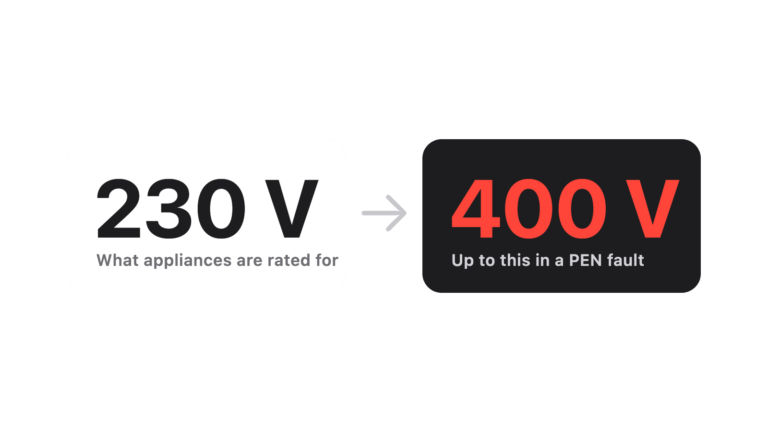
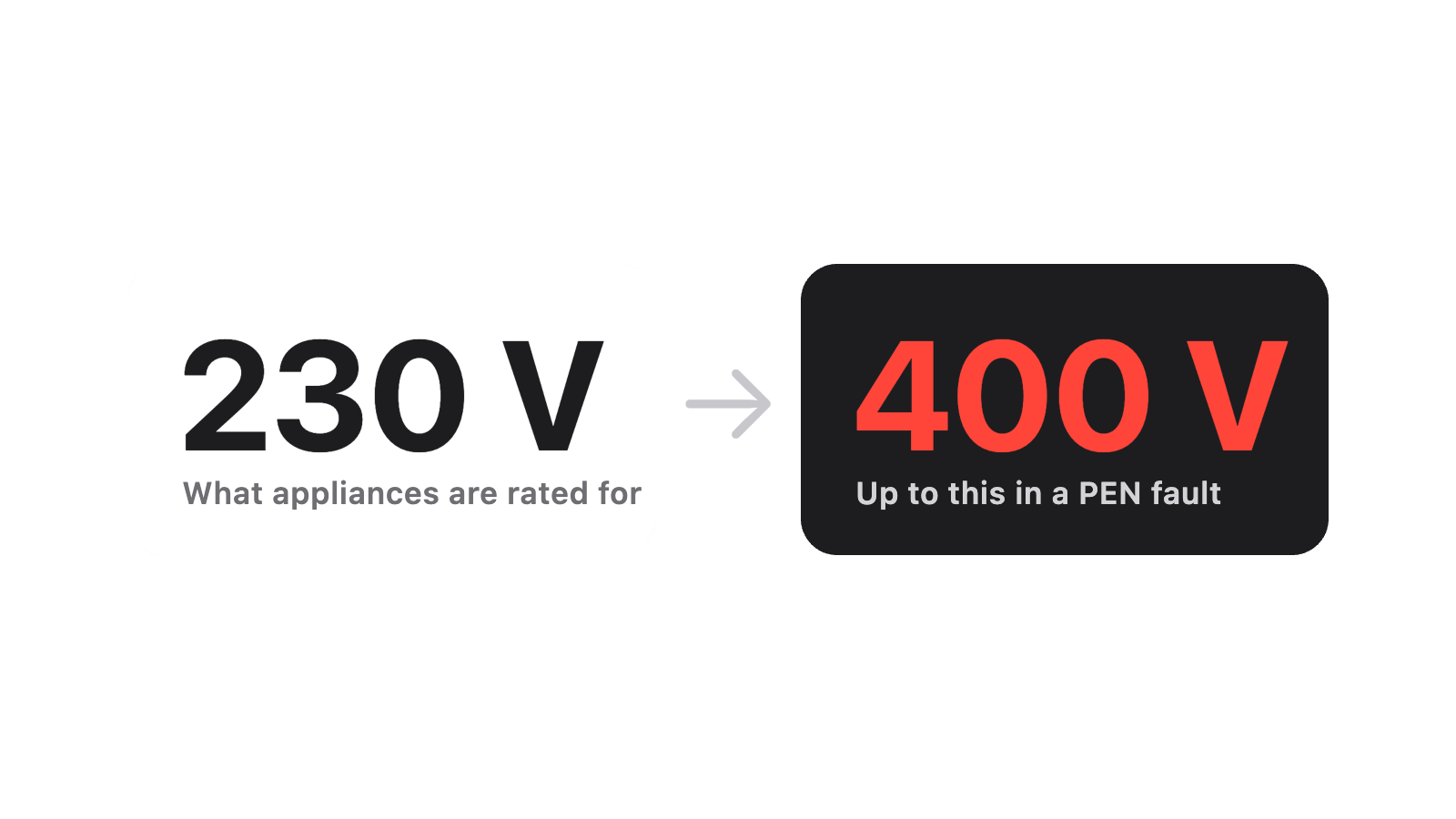
UK appliances are designed for a nominal supply of 230 V at 50 Hz. The law allows the supply to vary between 230 V +10% and −6%, which is 216.2 V to 253 V.
Manufacturers design and test for that window, plus a small margin. A typical label reads “220–240 V”, and many chargers and power supplies accept 100–240 V. Neither range comes close to 400 V.
| Condition | Voltage the appliance sees | Within its rating? |
|---|---|---|
| Normal supply | 216.2 V to 253 V | Yes |
| Single-phase PEN fault | Usually near normal, sometimes low | Usually |
| Three-phase PEN fault (neutral shift) | From near 0 V up to about 400 V | No |
| Any PEN fault: metal case to true earth (Class I) | Up to about 230 V | No, a shock risk |
So the honest answer is that appliances are rated for a healthy supply. Nothing in a normal rating covers a PEN fault.
What Happens to Appliances During a PEN Fault?
The effect depends on where the PEN breaks. There are two main cases.
Break on a Single-Phase Supply
If the PEN breaks on the single-phase cable to one property, the load current returns through the earthing and bonding. It may flow out through a metal water or gas pipe, or through a neighbour’s installation.
The supply voltage may stay close to normal or drop, depending on that return path. The bigger danger is that every earthed metal part rises above true earth. This includes appliance cases, radiators, taps, boilers and outside metalwork.
Break on a Three-Phase Main
Most streets are fed by a three-phase main, with houses spread across the three phases. If the PEN breaks on that main, the shared neutral point is lost. The neutral then drifts towards the most heavily loaded phase. Engineers call this neutral shift.
As a result:
- houses on the heavily loaded phase see a low voltage;
- houses on the lightly loaded phases see a high voltage, which can approach 400 V;
- all earthed metalwork can rise to a dangerous voltage above true earth.
What That Does to Equipment
| Equipment | Likely effect |
|---|---|
| Electronics (TVs, routers, boiler PCBs, smart meters, chargers) | Can fail within seconds. Surge components often burn out first. |
| Motors and compressors (fridges, pumps, washing machines) | Overheat at low voltage or burn out at high voltage. |
| Heating elements | At 400 V, an element draws roughly three times its rated power. That is a serious fire risk. |
| Class I appliances | The earthed metal case rises with the earthing. Touching it and true earth together can cause a severe shock. |
| Class II appliances | No earthed metal, so no direct touch risk. They can still be damaged by high voltage. |
Why Your Consumer Unit Will Not Save You
Standard protective devices are not designed to detect a PEN fault.
| Device | What it detects | Why it misses a PEN fault |
|---|---|---|
| MCB or fuse | Overcurrent and short circuits | A PEN fault rarely causes excess current in the circuit. |
| RCD or RCBO | Imbalance between line and neutral | Line and neutral current still match, so there is nothing to trip on. |
| SPD | Short transient spikes, such as lightning | A PEN fault can cause a sustained overvoltage, which can overload and destroy the SPD. |
| AFDD | Arcing in the fixed wiring | The break is usually on the network, outside the installation. |
An RCD also cannot remove the touch voltage. All the earthed metalwork rises together, and the RCD sees nothing wrong.
Warning Signs on Site
Customers often describe the symptoms before anyone names the fault. Watch out for:
- lights that dim or brighten when a large load switches on, in the property or next door;
- tingles or shocks from taps, radiators, showers or appliance cases;
- several appliances failing at once, often after a burning smell;
- neighbours reporting the same problems;
- current flowing in the main earthing or bonding conductors.
On a healthy system, a clamp meter on the main earthing conductor typically reads a few milliamps. A reading of several amps points to diverted neutral current. Find out more in Why You Really Must Measure Current.
What to Do If You Suspect a PEN Fault
- Do not touch exposed or extraneous metalwork, and keep everyone else away from it.
- Do not disconnect the main earthing conductor or any bonding. Doing so can put you in series with the fault current.
- Call 105 to report it to the local network operator. The call is free, and the line is open 24 hours a day.
- Switch off at the main switch if you can do so without touching earthed metal. This removes the property’s own load. However, it does not remove the touch voltage, because neighbours’ current can still flow through the earthing.
- Record what you saw: voltages, clamp readings, times and damaged equipment. This helps the network operator and any insurance claim.
The network operator owns the supply cable and the cut-out, and only they can repair a broken PEN. For isolation on site, follow our Correct Isolation Procedure.
How to Protect an Installation
You cannot stop a PEN breaking on the network. However, you can limit the harm it does. The current standard is BS 7671:2018+A4:2026, which replaced the previous version on 15 October 2026.
Where BS 7671 Already Requires It
Regulation 722.411.4.1 covers EV charge points on PME supplies, because a car body is a large metal object that people touch while standing on the ground. One option is an open-PEN detection device. The voltage-monitoring type disconnects all live conductors and the protective conductor within 5 seconds if the voltage goes outside 207–253 V.
These devices help, but they are not perfect. They measure line to neutral. On a three-phase network, the neutral can shift so that line to neutral still looks normal while the earth sits well above true earth.
PME is also prohibited or restricted in some locations, such as caravan pitches, boats and petrol filling stations.
Other Options
- TT earthing for outbuildings or equipment used outdoors, with RCD protection and a suitable earth electrode.
- An extra earth electrode to keep the touch voltage down. The IET gives an example where a 7 kW maximum demand needs about 2.1 Ω to keep touch voltage below 50 V. Values this low often need specialist arrangements.
- Good main bonding sized to Table 54.8 for PME, kept intact and labelled.
- Class II equipment outdoors, where practical, so there is no earthed metal to touch.
- Whole-installation monitoring devices that disconnect on abnormal voltage. Check that any device you fit is designed and tested for this purpose.
Every installation needs its own risk assessment. Always check the current wording of BS 7671, IET Guidance Note 5 and the manufacturer’s instructions.
Frequently Asked Questions
Can a PEN Fault Really Put 400 V on a 230 V Appliance?
Yes. When the PEN breaks on a three-phase main, a single-phase property can end up connected between two phases. The voltage at its sockets can then approach 400 V.
Will a Surge Protector Stop the Damage?
No. An SPD handles short spikes. A PEN fault can cause a sustained overvoltage, which can overload the SPD itself.
Are Class II Appliances Safe in a PEN Fault?
They carry no direct touch risk, because they have no earthed metal. However, high voltage can still damage them.
Who Pays for Damaged Appliances?
That depends on the cause. If the fault is on the network, contact the network operator and ask about its claims process. Keep records and keep the damaged items.
Does a New Consumer Unit Fix the Problem?
No. The fault is on the supply side. A new consumer unit does not detect a broken PEN or remove the touch voltage.
Key Takeaways
- Appliances are rated for a healthy 230 V supply, not for a PEN fault.
- A three-phase PEN fault can put up to about 400 V on single-phase equipment.
- Any PEN fault can make earthed metalwork dangerous to touch.
- MCBs, RCDs and SPDs do not protect against it.
- If you suspect one, keep clear of metalwork and call 105.
Sources
- IET Wiring Matters: Broken PEN
- IET Wiring Matters: How voltage drop can affect EV charge point open-PEN detection devices
- IET: Rise in deadly electrical faults increasing risk of fires across UK
- IET EngX: Open PEN Detection for 722.411.4.1 (Iv)
- IET: Amendment 4 (2026) to BS 7671:2018 Published
This article is general guidance for trained people. It does not replace BS 7671, manufacturers’ instructions or a risk assessment for the installation in front of you.